Showing posts with label other cultures. Show all posts

Monday, 4 March 2013

In The Beginning

In The Beginning:
Musuk Nolte for HAND/EYE
The beauty of Peru’s Pre-Columbian cultures
Peruvian textile production began more than 10,000 years ago as evidenced by artefacts recovered in the Guitarrero Cave of the Ancash region. The first inhabitants of the Andean region developed a vast and exquisite textile tradition to provide for personal warmth, as well as to pay tribute to their rulers and pay homage to their deities. Depending on its intended use, each piece was elaborated with a number of techniques, and the backstrap loom was exploited to its fullest, to create works of great aesthetic beauty. The refined tastes of both artisans and users can be discovered in these textiles.
The geography of Peru has effected the development of various cultures, each evolving its own level of organization, some of which were sufficiently complex to allow some of its members to specialize as craftsmen. To satisfy the needs of their respective societies, sophisticated textile techniques were developed in single-culture and pan-Andean contexts. The raw materials most utilized were native cotton (Gossypium barbadense L) produced in as many as eleven colors (cream, black, red, green, blue, grey, violet, beige, brown and their variants), fibers of Andean camelids with vicuña being the finest, and fibers extracted from various members of the agave family such as cabuya or maguey plants.
Peru’s first civilization was formed between 3000 and 2500 B.C. in the Supe Valle, with several communities established as urban centers which played a fundamental role in the distinct cultures that eventually emerged. Of some relevance is the recent discovery of a quipu, or group of knotted cords, used as a recording device by Peruvians some 5,000 years ago.
Many textile splendors were manifested in different eras and regions throughout history. The Chavin Culture (900 B.C. - 200 BCE) of the high Andean region produced cotton textiles illustrated with intricate personages which were also reproduced in stone sculptures. The colors of Chavin textiles bear some resemblance to sepia photos of the last century.

The Paracas Culture (700 B.C. - 200 BCE) demonstrated a command of dyeing techniques resulting in at least 79 different tonalities attained using by-products of various Andean plants and animals as dyestuffs. Robes have been discovered in grave goods which have maintained their original color, demonstrating (particularly in the embroideries of ancient Paracas) a still-unmatched chromatic richness. The symbolic language of these goods is rich with strange mythical creatures.
The Moche Culture (100 BCE - 700 CE) evolved on the northern coast, and its abundance of ceramic, metal and textile production is astounding. Feathers and small metal objects were incorporated into their clothing, resulting in original textures as well as a certain musical aspect.
The Tiahuanaco (200 ACE - 1000 CE) and Wari (500 CE -1000 CE), cultures of the high Andean plains and Ayacucho, respectively, are distinguished by the designs obtained through techniques similar to woven kilims. According to the research of Alan Sawyer, the Wari began with a traditional and conventional style inspired by Tiahuanaco textiles, but then moved on to incorporate geometric icons. Wari designs allowed a distortion of the icons to adapt them for use on fabric bands, eventually leading to increasing abstraction and colorplay. Wari textile design might be considered the most modern, with considerable bravura in spinning and weaving. The extraordinary quality of Wari fabrics is evidenced by a fragment with an unmatched density of 398 hand-spun threads per inch.
Textile production in the Chancay Culture (1100 CE - 1450 CE) surprises us with its diversity of backstrap loom techniques. Chancay weavers created a catalog of methods and designs to allow their customers to order goods to suit their personal tastes. Chancay weavers developed techniques which were applied to the production of various pieces: gauze, nettings, and flat-woven cotton cloths tie-dyed and assembled as patchwork. Some of the work is strikingly modern: the simplicity of repeated geometric patterns on a single piece coupled with bold color combinations have resulted in Chancay textiles being recognized as a source of inspiration for contemporary designers.

Incan textiles eventually dominated many of Peru’s regions. The elite enjoyed the service of female weavers kept in seclusion – said to be beautiful virgins. Woolen blankets, rugs and hangings were made across the Incan Empire for the palaces and temples. Woolen tunics were adorned with gold, precious stones and feathers. It is said that an Incan never wore the same outfit twice, which further demonstrates the importance that textiles held in the lives of Andean men and women.
Today, textiles continue to carry great importance in Andean life. From an early age, men and women learn to spin cotton, sheep’s wool and the lustrous fibers of Andean camelids. Though they’ve incorporated the use of the European pedal loom and have altered their designs in accordance with the diverse influences of colonialism and globalization, their distinct character has been maintained. One of the major additions to Andean textile customs has been the introduction of tailoring; previously, all the pieces were assembled from square or rectangle swatches taken directly from the loom.
It’s no coincidence that contemporary artisan clusters are found in the same areas where Pre-Columbian cultures developed. Regions with high rates of artisan production include Cajamarca, Ancash, Junín, Ayacucho, Puno and Cusco as well as in the northern coastal area now known as the Moche Route, which includes the provinces of La Libertad and Lambayeque. For present day Peruvians of these regions, globalization has presented an opportunity to contribute their talent and abilities to an ever-demanding and expanding economy. Deep and ancient cultural heritage is now an asset to be traded in the global marketplace.
Josefa Nolte is a Peruvian anthropologist who has worked in the craft development sector for 40 years. She is currently National Coordinator for the UN Joint Program for Inclusive Creative Industries in Peru.

Tuesday, 9 October 2012

Of Handbags and Hope

Of Handbags and Hope:
Courtesy of Sarah's Bag and Natalie Naccache
Lebanese women prisoners embroider handbags that jumpstart new lives
Despite Lebanon’s decades of internal strife and external conflict, its inhabitants remain upbeat, possessing an inbuilt love of life that few countries can match. Fashion designers and women prisoners here are no exceptions. While seemingly on opposite ends of the social spectrum, both now enjoy a wonderful symbiotic relationship through Sarah’s Bag.
Beirut-born Sarah Beydoun is the creator of Sarah’s Bag, a successful global fashion and accessories house adept at empowering underprivileged female prisoners. While Sarah was at university writing a thesis on vulnerable women, she worked with a non-governmental organization that supports vocational training in Lebanon's jails. What started out as a rehabilitation exercise for these women blossomed into a thriving international designer label coveted by the likes of actress Catherine Deneuve and Queen Rania of Jordan.

Sarah’s Bag now has boutiques in the Middle East, Africa and in the United States. To learn more, visit www.sarahsbag.com Cheryl Robertson is a journalist based in Dubai. www.simbacom.com/cheryl


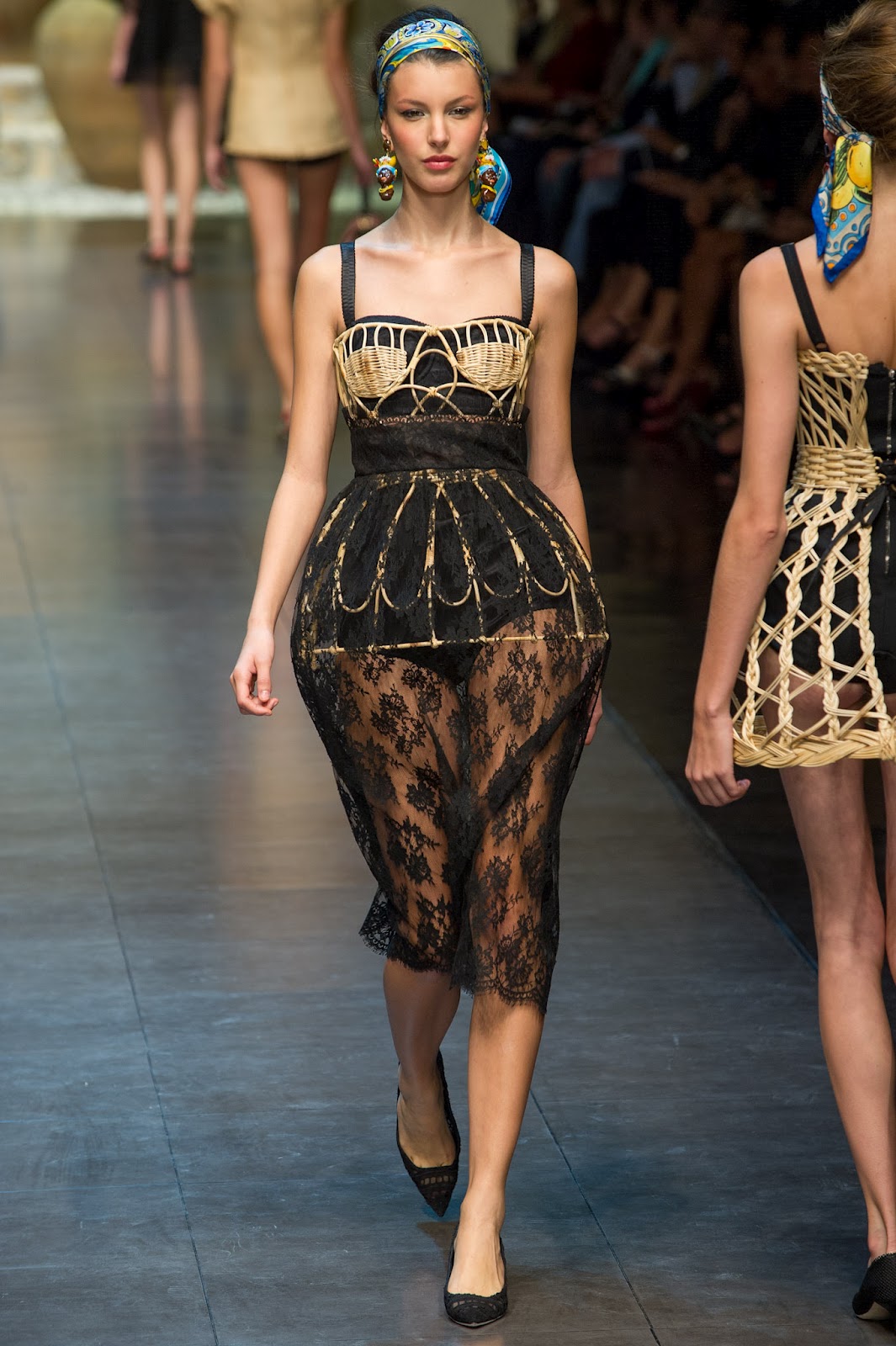
DOLCE & GABBANA 2013 S/S COLLECTION RUNWAY WITH VIDEO (WOMAN)

DOLCE & GABBANA 2013 S/S COLLECTION RUNWAY WITH VIDEO (WOMAN):


Wednesday, 25 January 2012

Young Brides, Old Shirts

Young Brides, Old Shirts:


Courtesy of The Museum of International Folk Art


Macedonian Embroidered Dress

On October 1st 2011, the Museum of International Folk Art in Santa Fe presented an exciting collection of Macedonian dress worn by the women of Orthodox Christian villages. These beautiful artifacts have finally found a world stage thanks to a large donation on behalf of the Macedonian Arts Council. Young Brides, Old Shirts focuses on the rich textile traditions of this small land locked country, displaying twenty-seven mannequins dressed in gorgeous layers of jewelry and garments. This assembling of clothing dates back to 1850-1950, and is ranked as some of the finest textiles in the world. Museum curator Bobbie Sumberg says, “We want people to get lost in the intricacy of these pieces and to see their relation to other pieces.”


"Young Brides, Old Shirts refers to a Macedonian folk song." Folk art saturates the country, finding its place in the traditional dress, architecture, dance, and decor. Specific embroidery, motifs, and color schemes reflect the diverse tastes of ethnic groups throughout the country. These styles become an unspoken cultural language, documenting centuries of tradition. Sumberg says, “The visual system of meaning created by the Macedonian women living in villages indicates to a knowing eye where the wearer of a particular costume was in the cycle of life. From puberty through betrothal, marriage, child bearing, and old age, dress changed to reflect status change.”


Colors range from village to village, from rich reds to brilliant shades of blue. Red was commonly used due to the abundance of Eurasian root madder, adored for its symbolic meaning of magical protection and vigor. Garments were typically made from wool, linen, cotton and in particular regions, silk worms were raised for their fine thread. A girl’s wedding or engagement marked the height of her weaving and sewing skills and when a young woman announced her readiness for marriage, this was when her most sophisticated outfit was worn. A woman would wear parts of her bridal dress for up to three years after the ceremony. As one aged, her attire would simplify and traditionally she was buried in her bridal dress, explaining why so few garments remain.


These textiles not only express individual artistic creativity, but they embody a sense of fortitude and monastic simplicity which kept their spirits alive throughout centuries of foreign rule. Macedonia has a turbulent history of wars and colonization that has deeply influenced the country's aesthetic. "When Western Macedonia was divided into smaller regional units, different ethnic traits arose, becoming a mosaic of stunning costumes throughout the country." Sumberg adds, “There is a sense of congruence and ownership that grew between the maker and her creation. The formalizing of these choices resulted in a kind of boundary- this is ours and not yours; we are us and not you- that also served to identify a person as insider or outsider- an unspoken language of society.”


Young Brides, Old Shirts: Macedonian Embroidered Dress opens at the Museum of International Folk Art runs through January 6, 2013. For more information, please visit www.internationalfolkart.org


Wednesday, 9 November 2011

Tues 8th Nov: threeASFOUR "inSALAAm inSHALLOm"

Tues 8th Nov: threeASFOUR "inSALAAm inSHALLOm":


threeASFOUR inSALAAM in SHALOM SHOW video by : brian gonzalezI have come to New York city to visit my friends threeASFOUR to celebrate our 10 year anniversary of meeting and my induction to their lives as the first intern to enter the silver loft studio in China town. A decade prior to this, the girls ADi and ANGE found each other whilst studying fashion in Germany having both originated from Israel and Tajikistan respectively. Ever since I have spent time with the crew travelling to different cities for projects, it has always felt like united nations crossing borders with this combined cultural collective. The third member of the triangle from Palestinian descent, born and raised in Lebanon is GABi whose surname the group have taken as the label's title, meaning bird. The immediacy of cross pollination from working as a multicultural team has always informed designs and ideas of mixed flavours and an amalgamated magical unique vision. For the first time, the underpinning structure of the dynamic has been explored with a collection entitled "InSHALLOm" combining the similarities between Jewish and Arab aesthetics. Not only are these cultures literally combined within the group but also incidentally traditionally bound to one another visually.
Here are snaps I have taken of the inspiration imagery, sketches, construction and final garments comprising in a myriad of contrasting materials. Silks are printed in repeat patterns morphed from six-pointed stars and mixed scale kaffiyeh woven check. This 2D emblem of fishing net becomes 3D with panels of net and a bodice sewn into the star shape from individual lengths of twine. Talisman swing from seams with silver Hamsa hands hanging like sequins in conjunction with the glass evil eyes it is believed to defend. This blue is carried thru from a breastplate embellished with eye beads to another, pieced together from broken colour glazed ceramics. Further religious motifs incorporated result in a necklace to cover the décolletage constructed from two upended shofar ram horns (used for prayer at Synagogue). Underneath the detailed show-pieces are signature tailored separates and skin tight stretch body stockings which become almost animal print camouflage in composition. My favourite look of all is super sexy swimwear shown in a white and black version like ying and yang, hand in hand down the catwalk. Which brings me to the show...........
In this film of the runway, you will see from the bird's eyes perspective camera angle that the floor was taped out with the lines of the star for the girls to follow. This is just a hint at a much larger plan in the pipeline, culminating in an exhibition at Beit Ha’ir museum in Tel Aviv the end of this month. This second stage extends the collection, incorporating photography, film, live music and performance from various artists invited to take part. Curating the show, threeASFOUR have brought together practitioners from New York, Israel and Palestine including Yoko Ono, Jessica Mitrani, Bothina Millhem and Shari Diamond. To keep up to date with the project and find out all the latest developments follow either their Tumblr, Facebook or Twitter.