Future Heirlooms-Kelsey Viola Wiskirchen:
I recently stumbled upon the work of
Kelsey Viola Wiskirchen when I was researching a call of some kind and when I stumbled upon it…my mouth went agape with excitement. I found her style of drawing with thread incredibly sensitive and was totally intrigued by her conceptual approach towards community. Kelsey has experimented with working with communities and creating communities through the healing power of the thread in many ways and that has resulted in everything from sophisticated exhibitions to quirky “happenings.” But to observe her exploration and empathy, compassion and genuine interest in others via her work is really inspiring and exciting. So this is the first step to getting to know her work a little more, join me…
 Tell us a bit about your background?
I grew up in Kirksville, Missouri and spent most of my time running around outside, doing craft projects, and making a mess in my mom’s kitchen. My dad thought I would grow up to be a scientist because I was always peering at plants and bugs. My Grandma Wiskirchen taught me how to hand-embroider when I was 7. She drew flowers onto a piece of fabric and had me stitch over her lines. Some of my fondest childhood memories and best education happened on her farm.
What is your background/education as an artist? Are you formally trained in craft and fibers?
I received my BFA in Fibers from Truman State University, and my MFA in Fibers from the Herberger Institute for Design and the Arts at Arizona State University.
 Can you give us a 3 sentence or less artist statement of your current body of work?
Cloth serves many functions – warmth and protection, art, and in many cases, it empowers the people who create it by giving them a means to support their families. My textile work is a reflection on experiences shared with individuals and groups of people, and the stories that have been shared. I am most particularly interested in communities of women, and the passing on of stories and traditions through generations.
 How does working with embroidery/stitching affect the conceptual aspect of your work? What drew you to stitching?
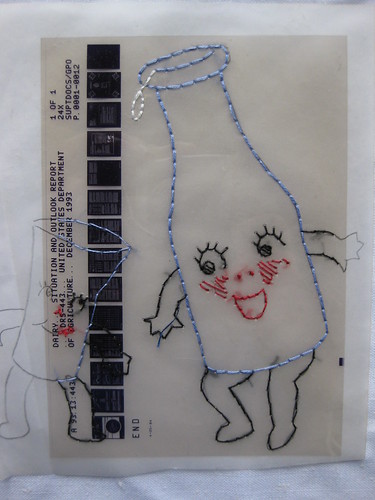
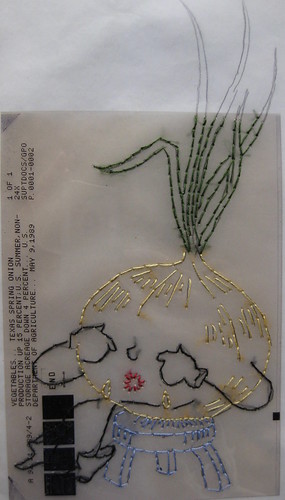
Stitching is the process that I am most naturally inclined to do. I benefit from the meditative effects of this work, and find that time stitching provides a balance to the time I spend with others. My community work is focused on helping others find healing and empowerment through textiles, so there is a direct relationship to my choice to use it in my personal studio practice. As a drawing medium, thread and fabric have expressive and tactile qualities of dimension and texture. I stitch onto loosely woven fabric so that the images can cast a shadow and be layered to create depth. In this way, transparency symbolizes the impact that time and distance have on the memory of shared experience.
 Can you talk about the role of “community” in your work?
Community is a broad term – Sometimes my work actively involves a specific public community, and sometimes it is a more quiet reflection on individual community members I have spent time with. My work and my life rely on being with others. When I was learning to weave, I realized that no matter how badly I was feeling on an individual day, the softness of thread and the repetition of working with my hands was a cure for what was troubling me. I want to share this with others, which has led me to a life involving teaching and community outreach through textiles. I have learned that working together is a natural means to conversation and comfort with others. I enjoy both teaching and learning, so I often seek out experiences where I can do both. When I was with PAZA, the women’s cooperative in Bolivia, I taught sewing to the young girls while learning the traditional weaving from one of the mothers. Working with members of the community (whatever community I find myself in) gives me a sense of purpose, and the theme carries over into my artwork.
On your website your refer to duality and how your work and use of thread discusses the duality of life, can you talk about this a bit?
The more I engage with others, the more clearly I see connections between diverse groups of people. Similarly, the creation and use of cloth is universal. The physical materiality and pliability of thread appeal to my sensibilities. For me, it is the perfect means to create a tangible object out of something as intangible as conversation, memory, and experience. I see thread as a symbol of duality— representative of individual fragility and strength when woven into cloth. In contemporary society, we are faced with both our past and our future, the duality of tradition and innovation. It is vital to preserve our histories while moving forward together. I believe that collaborative efforts are a key to solving many of the world’s problems, and the people I meet give me great inspiration and optimism for the future.
Annette B. Weiner and Jane Schneider say it perfectly in the introduction to Cloth and Human Experience, “Cloth metaphors echo from many parts of the world, both today and in the past. Social scientists and laypersons regularly describe society as fabric, woven or knit together. Cloth as a metaphor for society, thread for social relations, express more than connectedness, however. The softness and ultimate fragility of these materials capture the vulnerability of humans, whose every relationship is transient.”
What lead you to make your installation “handed on” lifesize? How do you think that the way the work was installed affected the viewers understanding and interaction with the work ?
I hoped for viewers to physically experience the work by walking among the images of the women. Viewing a small image can be a passive experience. I stitched the life-sized figures onto transparent fabric so that layering and shadow would become elements of the work, and so the physical presence of a viewer walking through would also become a layer in the installation.
 What did the text element add to the overall exhibit?
Each portrait included a line of text which was a part of the individual woman’s story. When hung from the ceiling, I leveled each work so this line of text was at the same height throughout the installation. The line became a visual continuity, to represent the connection between each of the individuals represented.
There was an additional text element (mentioned in the question below), in which I collected stories from the public and stitched each story onto a panel of woven fabric. Throughout the course of the exhibition, I continued to collect more stories. This was a way for viewers of the work to become an active participant. I was in the gallery space with my loom, weaving fabric for these stories to be stitched onto. This collection is still ongoing. I am interested in what gets passed down through generations, and what memories people have from women in their own lives. If anyone reading your interview is interested in sharing a story, they are more than welcome to email me!
Can you talk about the projects where you incorporate the public, inviting them to be participants in the work?
My project Us Together involved embroidering with community members. I built a large embroidery hoop, about 15 feet in diameter, and invited anyone who wanted to stitch to take part. I hoped for the action of sewing to become a means for conversation, and was thinking about the idea of a round-table discussion, and also the history of knitting circles. I stitched with children, adults, men, and women. It was fun to find out each individual’s motivation to participate. One woman found out she was going to be having a daughter and wanted to learn to embroider baby clothes. Some of the participants already knew how to embroider and wanted to sit and talk while embroidering a design. The challenge with projects like this is giving up aesthetic control. Each person who participated became an owner of the work. For me, this work was about the interaction and the process, rather than the end result.
For my project Handed On, I collected stories in writing. I asked participants to share a memory of something they learned from their mothers, grandmothers, or other woman in their life. For this project, I wove the fabric and stitched the stories. My goal was to document the stories that were shared in the form of a tangible, physical woven object. The public was less involved in the physical creation of the work, but I was still facilitating a means for individuals to contribute their stories.
My absolute favorite part about working with the public is hearing the stories people have to tell. I feel privileged to have the opportunity to learn about people’s histories and incorporate them into my work.

 You have worked with a number of weaving collectives in other parts of the world- how has this affected your ideas towards art? weaving as part of history? and women’s roles?
In 2010, I spent a month in Bolivia with Projecto Artesania Zona Andina (PAZA), a women’s weaving cooperative consisting of three generations of women weaving and sewing together to support their families. There, I learned the double-weave technique that the Bolivian women have been using for centuries to create fabric for clothing, coverings, and chuspa shoulder bags. In 2011, I spent the summer in Limpopo, South Africa with Mapusha Weaving Cooperative, a women’s weaving cooperative with a similar purpose. The women of Mapusha create watercolor-like tapestry weavings 5 meters high on a loom made of boards with nails spaced each centimeter for tying the warp threads. More information about these cooperatives can be found at www.pazabolivia.org and www.mapusha.org.
I have been very fortunate to have the opportunity to work with the women in these cooperatives. The rich history and tradition is part of what I love about using textiles in my work. I think about the people who have woven all throughout time – I use textiles as a mode of expression, but am very aware of the utility and history of weaving. I have been inspired to meet women in other parts of the world finding empowerment through creating textiles. They are sustaining a tradition that has been passed down through generations, but they are also creating unique works of art and continuing to try new things.
What is the next direction or step for your work?
Right now, I am focusing on the St. Louis community. Craft Alliance has several community outreach programs that I am involved in. I am also volunteering at the Crime Victim Advocacy Center in St. Louis. I am collaborating with a social worker to facilitate an art therapy group there for victims of trauma. We use weaving as a way to discuss and practice mindfulness and meditation.
In the studio, I am working on developing the way I use thread as a drawing medium. My most recent work involves exploring the density of thread as a way to create depth and space in an image. I am also working on sculptural book forms with layers of fabric which include images and stories from the community members I have been working with.
You are currently at am artist residency can you tell us about that experience for you?
My residency at Craft Alliance in St. Louis is for 12 months, so I have an entire year of focused time to develop a new body of work. I need time for experimentation, research, and conversation to experience growth in my studio practice. Craft Alliance has provided me with many resources in the community. I have a designated studio space, I teach fiber art classes to community members, and am surrounded by other artists for feedback and camaraderie. I feel very lucky to have the opportunity to do this for a whole year!
What was the last really inspiring work of art you saw and why?
Last week I saw a video work, Street, by James Nares at the St. Louis Public Art Museum. He filmed people on the streets of Manhattan and slowed the footage extremely, so a quick glance or blink became a slow, deliberate gesture. The facial expressions he captured in slow, panning shots had me mesmerized for nearly an hour. Although quite different from most work I spend time looking at, it inspired me to think about the subtle interactions we have with others.
What do you struggle with most as an artist?
Finding time to do everything! I want to give 100% of my time to the studio and 100% of my time to teaching, and that alone is 200%. In addition to my residency at Craft Alliance, I am teaching Fiber Art at Truman State University. I am always doing research and trying to learn new techniques. I also love to bake and grow plants. I want to become fluent in Spanish and have been trying to learn to play the guitar for almost 10 years. My book list grows exponentially faster than I can read them all. At least life is never boring!
Where can we see your work?
My website,
www.kelseyviola.com
This link is to a video about my work by
Chakris Kussalanant (This recently won best video in the textile category of the Global Skin Vimeo competition.)
My studio at Craft Alliance is open to the public. It is located at 501 N Grand in St. Louis, MO. My work is on exhibit at Craft Alliance, and I also teach community classes there. Information about Craft Alliance, and the catalog of classes can be found at www.craftalliance.org
In June, I will have an exhibition at Craft Alliance showing the work produced during my residency. I will also have work on display at the Surface Design Association conference this summer in San Antonio, Texas at Anarte Gallery.
Look for more from me featuring Kelsey’s work.
Until next time keep your needle threaded.
 Joetta Maue
is a full-time artist, writer, and curator with a focus on the art of the needle. Her most recent body of work is a series of embroideries and images exploring intimacy. Joetta exhibits her work throughout the United States and internationally, and authors the critical blog
Little Yellowbird as well as regularly contributes to Mr. X Stitch.