Showing posts with label shape. Show all posts

Monday, 4 March 2013

New work on the way

New work on the way:

New work is on the way, this is a bit of a taster of whats to come. I will have more news in the next couple of weeks.

Tuesday, 9 October 2012

Sunday, 18 March 2012

Studio Highlight: JuJu Papers

Studio Highlight: JuJu Papers:


…and I am also thrilled to share the work of Portland, Oregon based JuJu Papers! JuJu Papers was founded by designer Avery Thatcher in 2010. Avery and her team print every wallpaper roll by hand and take special care to use water based inks on creamy, durable, sustainably harvested paper.
“Primarily inspired by folk art of all kinds, our designs suggest the simplicity of an elegant old-fashioned signature, or the impossibly perfect collection of driftwood and sea glass on the shore. It’s the quick gesture that gives our wallpapers their musical expression. We offer bespoke services, and all of our papers are available in custom colors. Designers and dealers should contact Avery Thatcher directly.”
Please check out their website to view the full collection. Enjoy!

Tuesday, 17 January 2012

FaceMaker

FaceMaker:
FaceMaker
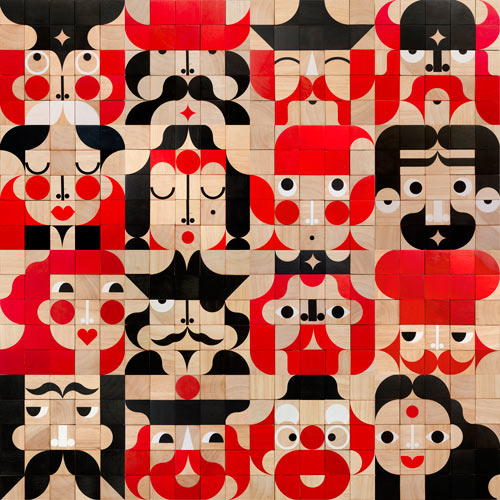
UK design studio millergoodman creates modern classic artistic inspirational open ended toys for kids and adults such as the wooden block games ShapeMaker and PlayShapes. They launched a new block toy called FaceMaker at the London show HOME that just debuted this past week.
FaceMaker
Explore your creativity and discover thousands of unique faces to be made with these 25 wooden blocks. Will you make the cowboy, the queen or a character only you can imagine? These environmentally-friendly, hand printed blocks are loads of fun and whatever your age you’ll be inspired to play.
FaceMaker
Also for HOME, they produced a deluxe version of Shape/FaceMaker in a black wooden frame, allowing the puzzles to be played with in the frame and then hung on the wall.
FaceMaker

Share This: Twitter | Facebook | Discover more great design by following Design Milk on Twitter and Facebook.

© 2012 Design Milk | Posted by Jaime in Art, Home Furnishings, Style & Fashion | Permalink | No comments

Thursday, 29 September 2011

Prep

Prep:
I am having fun preparing for The People's Print 'Born to be Wild' workshop at the V&A based on the current Post Modernism exhibition. The workshop will study various Post Modernism design styles that will be re-created by handmade methods and manipulated digitally to create the first co-design swatch book shared by all the participants, ready to print, make and wear.
Being a design student in the 80's, I am in my element! re-connecting with design, art and music styles from 1970 -1970 that now have a significant place in history and that was a part of my design education.
With my main passion for pattern and textiles, I have been looking at French born Nathalie Du Pasquier, a founder member of the Memphis group until 1986 where she was the designer of fabrics, textiles, carpets, furniture and objects. After the Memphis group broke up in 1987 Nathalie carried on to become a successful painter. Her work still has a love of colour, compostion and everyday objects that surround her.
Nathalie Du Pasquier.
Follow The People's Print workshop here


Cutting Deep

Cutting Deep:

Michael Velliquette’s paper sculptures

Michael Velliquette is a contemporary mixed media sculptor currently working primarily with paper. His sculptures, using vibrant colors and bold forms, are visually and structurally complex. Using paper and glue with gator board (a heavy-duty polyester graphic arts board that is both lightweight and strong, and often used for exhibits or signs) and bristol board (heavyweight all purpose card stock) as understructure, he creates densely detailed and dimensionally complex sculptural collages that are then mounted on the wall. Velliquette carefully constructs these paper sculptures layer by layer, incorporating a range of sizes and shapes, including circles and other geometric forms, simple paper chains, and pieces cut to resemble feathers, all of which he then folds, bends and rolls into place. Several examples of his work can currently be seen in the exhibit Paperwork in 3D at the Shelburne Museum in Vermont through October 30th and at Chromatopia, a solo show at the Lawton Gallery at the University of Wisconsin-Green Bay until October 6th.


Velliquette's early work involved various media such as installation, paper sculpture, drawings and ceramics. His current work evolved from his background in mixed-media sculpture and installation, where paper was often only one component among many. He explains: "At the time my work was about transforming conventional craft or building materials into spectacle objects. But as the paper works evolved I began to look for ways to move beyond their inherent flatness to achieve the same sense of immersion that had been such an important part of my previous installation work. I spent time looking at other art forms like mosaic, relief sculpture, collage and other paper-crafting traditions, and I have gone on to incorporate aspects of these forms into my work. The results have been ever-increasing levels of visual and structural complexity."


On being asked how his work might change and in what new direction he might be going, Velliquette said, "In recent work I've been painting the paper prior to using it to construct the sculptures. It's given me a lot of great ideas for marking on the surfaces. It seems like a natural extension of the material with great potential. So, I've also been spending more time developing my drawings in relationship to these sculptural works and am moving towards a greater integration of the two."


His recent work seems to reference religious objects and ritualistic icons such as totems, stupas, altars and masks. He takes inspiration from sources that include dreams, spirituality, world myths and the occult. "The apocalyptic, the mythic, and the decorative are spoken through a method that embraces, by turns, compulsion,, ritual and the fanciful" writes contemporary art historian Michael Jay McClure in Laws of the Unconcious, a book surveying Velliquette's early career. In Awaken And Free What Has Been Asleep, a solo exhibition at DCKT Contemporary in New York City this spring, Velliquette's work was influenced by the practice of sigilization, an occult-based method for developing personal symbols by which the words of a statement of intent are reduced to a formal design.

For example along the margins of each drawing in one series, "Good Ciphers 1-12" are handwritten statements like "Opening to a deeper sense of self," accompanied by gestoral rune-like symbols made from the letters of the statement. Those symbols are then repeated on a larger scale and more elaborately articulated. The sculptural works are also derived from sigils and convey a ceremonial aesthetic. "Meat Eater" appears to be a mask of a creature that is part vegetable, part animal. Works such as "Flambeau" and "Illumine" suggest symbolic lights while "Chromasoul" and "Lil' Orphist" reference the power of color. "Grey Guard," one of his few achromatic works, allows viewers greater access into the complexities of the work's construction. In a New York Times article, "Power Tower" is described as being "shrinelike," as well as being reminiscent of party decorations and grade school art projects. In this show Velliquette's paper sculptures and drawings showed an expanded engagement with ornamental abstraction. His bold new forms evolved from a self-described "rite" of meditation, reflection and drawing, and showed a heightened prowess with the process of cutting, layering and gluing his colored paper shapes.


In Chromatopia, Velliquette shows his continuing interest in the interaction of form and color. The works are infused with aspects of tantric drawing, totems, sacred architecture and votive statuary. Four distinct series make up this installation, including miniature gouache paintings, mixed media drawings, paper constructions and plaster sculptures. A statement from the gallery states that "Collectively, the works are suggestive of relics or artifacts from a culture devoted to the worship of vivid hues and complex patterning."


In a description of his work of 2010-2011, Velliquette states: "For me, these works have partly become an exploration of the way emotional responses can be cued by such basic formal elements as color, line, shape, texture and pattern. But these works also speak somewhat about spiritually driven object-making and devotional ornamentation." He also declares: "I also see my recent works as a reaction against the current economic environment. In times of crisis, people often turn to religion and faith. For me, I draw a similar sense of strength from my studio practice. As the country was drawing deeper into recession, everything I was hearing in the media was about shortage and scarcity. I wanted my work to express abundance and exuberance, and for the viewer to experience an aesthetic of plenitude. I get a lot of inspiration from visual density, and it keeps me feeling positive and energized."


Velliquette lives and works in Madison, Wisconsin, where he is on the art faculty of the University of Wisconsin-Madison. He has had numerous solo exhibitions around the country, including Awaken And Free What Has Been Asleep at DCKT Contemporary in New York City in the spring of this year, and participated in many group exhibitions in the U.S. and abroad, including Slash: Paper Under the Knife at the Museum of Arts and Design in New York City and Psychedelic: Optical and Visionary Art Since the 1960s at the San Antonio Museum of Art in San Antonio, Texas. He also has two solo shows upcoming: at Blythe Projects in Culver City, California in 2012 and at the Clough-Hanson Gallery at Rhodes College in Memphis, Tennessee in 2013. He is represented by DCKT Contemporary in New York City as well as by the David Shelton Gallery in San Antonio, Texas.


For more information, visit www.velliquette.com; www.shelburnemuseum.com;

www.uwgb.edu/lawton.

Michael Velliquette: Lairs of the Unconscious, Devibook, San Antonio, Texas, 2011, available on Amazon.com
.


Wednesday, 14 September 2011

Mia Cullin

Mia Cullin: Mia Cullin‘s textiles put an emphasis on handcrafted construction and geometric assemblies inspired by folding and origami.

Trine Elmkvist

Trine Elmkvist:
Trine Elmkvist, 29. The Danish Design School, Textile Graduate 2010.

-specialism: Knitwear Textiles.


Design Background:

I have been sewing and making clothes for many years, entering different kinds of fashion schools and I have an education as a teacher in handcrafts from Odense Håndarbejdsseminarie.

I also spent my first three years at The Danish Designschool in the fashion department.

At my MA I moved to the textile department, and I discovered that I do my best work when I combine working with the body with a strong focus on colors and textures. Hand knitting and other techniques like crochet and tatting has always been a passion of mine. I love that I can keep developing my work through these things.

What was the most valuable you learned before starting at your education?

It was a great advantage to be able to cut patterns and sew before entering the design school. In that way I had more time to focus on all of the other challenges.


Project title:

Piece By Piece

Inspiration:

This project is based on the search of an experimental work method.

I used the idea of collages as the main theme of the project.

Based on that idea, I worked with combining pieces knitted in different materials, textures and colors. My focus was on the interactions between the shape of the pieces and the shape of the body, and the interaction between de different textures and nuances of colors.


Where do you get inspiration from in general?

Mainly from nature. Things like birds, plants and clouds. It is a never ending source of inspiration for me. I also look at art, both new and old.

And sometimes, like in my last project, the main inspiration is the material and the work method.


How is your process when you design?

It is very linear. I collect inspiration like pictures and materials, and work with the concept until I have enough for experimenting in 1:1 with the real materials. Then, I keep on experimenting until I have enough ideas for making a collection.


What do you find most difficult about the design process?

The finishing part. Like pictures, styling and figuring out how to explain it to everybody else.

What are your strenghts?

I am always very sure of my technical skills. And I think I have a very good sense of colors.

What are your weaknesses?

The same as the most difficult parts of the proces.


Describe your collection with three words?

Experimental, heavy, feminine

What techniques did you use:

The collection is made from pieces that are knitted or croched by hand. Some of the yarn I used I made myself on a knitting machine with motor, to make it thick enough.

I also made my own yarn from felt that I dyed and cut. The same material is used for the fringes on the jacket.


Which technique was the most difficult?

The knitting and crochet techniques are actually very basic. The biggest challenge was how to gather the different techniques in a nice way.

Do you have a technical or conceptual approach to designing?

Definitely technical.

Which garment was most difficult to make?

The blue one. It took a lot of testing to get the pieces and the negative space in between them to work.


Which garment took the longest to make?

The first one. It was the light pink one with the big shoulders. Not because it was more difficult than the others, but it took a lot of time to figure out how to work with the pieces on the dummy and how to gather the pieces.


Which garment is your favorite?

It changes from day to day. Right now it´s the blue one, because of the level of complexity.

How long did you work on this project?

4 months.

What made you pursue knitwear?

I kind of defined it myself, by combining my education. So now I am somewhere between a fashion and a textile designer. And that fits me very well.

I think I pursued this because I kept searching for the “place” where I could make my best work.


During your education, which project has been your favorite?

Definitely this one. This is the project where I have really found my way to work with knitwear.

I also loved one of the first projects we did, I think it was as a 1. year students.

We worked with the concept of time, and I made posters. Something I have never done before or after. It was a time where everything was possible, and we were learning the many opportunities of the design world.

How were the school?

I loved my school. There are always things that can be better, but most of all it is a great gift to be surrounded by people that have the same passion as you.

What advice would you give new students?

Listen to yourself, and make sure that you are doing what fits you best.


Which fellow students would you like to highlight?

My friend, Ulrik Martin Larsen, who was my photographer for this project.

We started the education together, but he finished a bit before me, now doing a PhD at Borås.

He is always a great inspiration.

Contact info:

t_elmkvist@yahoo.com

from spot on textiles